|
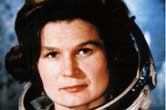
This Cosmonauts' Day, celebrated in Russia on April 12, will mark an important date: 40 years have passed since Yury Gagarin's first flight into space. A great deal is known about the world's first man in space, but much less is known about the first female cosmonaut, Valentina Tereshkova, who followed Gagarin into space two years later. In June 1963, Tereshkova became a legend when she was the world's first woman to blast off into space. For her three-day solo flight aboard the Vostok-6, she was presented with the prestigious Hero of the Soviet Union award.
Indeed, her achievement has not been duplicated to this day. She remains the only woman in the world to have made a solo space flight, serving as her own commander, flight engineer and crew. In recognition of her efforts, the International Women of the Year Association awarded the 63-year-old cosmonaut their highest award last fall: Woman of the Century.
The story of her success reads like an American dream: A poor factory worker from provincial Yaroslavl, Tereshkova had dreamed since childhood about the sky. With great difficulty and determination, she got what she wanted, and became a symbol of her country and its glory. Nikita Khrushchev himself was present at her marriage ceremony to cosmonaut Andrian Nikolayev. But their union did not lead, as many hoped, to the creation of a model space family. The marriage collapsed after Tereshkova gave birth to a daughter.
A resident of Star City, northeast of Moscow, the former cosmonaut currently heads the government center for international scientific and cultural cooperation. And while she usually avoids speaking to the press, Tereshkova recently granted this rare interview to The Moscow Times.
Q:
After your space flight there were rumors that you were taken out of the ship literally half-dead and were very ill for the next three years. Is there any truth to this?
A:
That is absolute nonsense, one of the stupid and ridiculous rumors that has been spread about me. After all, my condition, every move I made during the flight, was recorded. I had a very large research program and instead of the planned two days, I was in space for three days. But nevertheless, I carried out all of my tasks. And if I was "half-dead," is it really possible that I could have done that? After all, I was alone on the ship.
Of course, the flight was very difficult, a terrible strain on my body — particularly during the landing. We, the first group of cosmonauts, were selected according to very strict criteria; we were the strongest of the strongest and healthiest. Moreover, we trained for our flights so intensively — with such excessive caution and exertion — that the flight itself was much easier to endure than we expected. Later on, the training was more merciful, because it became clear that the flight itself did not require such the unbelievable test of strength we experienced during training.
Q:
What about a return flight? How come you never went back?
A:
I wanted very badly to be in space once. You might say I was eager to go again. In 1965 they discussed a possible second flight, but it did not happen.
Q:
Did you know Yury Gagarin very well?
A:
Yes. We [all] lived together in Star City. We studied together at the Zhukovsky Air Force Academy. After graduation, we were both selected as candidates for graduate studies in the sciences. He was unusually colorful, sincere and unselfish. He attracted everyone to him like a magnet. I believe we never fully appreciated the significance of his flight.
Q:
Valentina Vladimirovna, you could easily become a deputy of the State Duma representing any party. You have never considered going into politics?
A:
Never. For what purpose? I became a member of the Communist Party of the Soviet Union in 1962 in a factory in Yaroslavl. For me that was a great honor. The ideals of the party were close to me, and I have tried to adhere to those principles all of my life. In essence, they are the same as the Ten Commandments in the Bible. And I will never change my convictions. These days it is very fashionable to condemn everything that came before perestroika. As a result, the breakthroughs achieved in science, technology and industry during those years are forgotten.
Q:
Do you mean to say the authorities are hypocritical about the past?
A:
I am saying that everyone should do what he or she is good at. They should do what they love. I always did what I loved — in the space program and in my present work. I enjoy introducing foreign governments to our achievements in the areas of culture, science and technology. And even now, despite everything, there are many such achievements. Our people are unusually gifted and talented.
Q:
What do you think about what is happening in Russia today?
A:
Like every person who loves and is devoted to his homeland, I find it difficult to reconcile myself with our country's current condition. But in our history we have suffered far worse days and still came out victorious. I am confident that sooner or later, Russia will become a successful country.
Q:
How did you react to the decision of the [London-based] International Women of the Year Association to name you "Woman of the Century?
A:
It was quite unexpected for me because that organization had already named me "Woman of the Year" in 1984. It is a great honor. I see it first of all as a reward for our country. After all, it was granted to me in recognition of my achievements in space. Could I have achieved all that on my own? Of course not.
Q:
Do you continue to follow research on space issues?
A:
Of course. Anyone who has spent any time in space will love it for the rest of their lives. That is not just my personal opinion, but that of all the cosmonauts I know. We pay close attention to and feel anxious about every flight, every event. Now, for example, we are all very sad that the Mir was deorbited. To be honest, that was a tragic event for all of us.
Q:
How about your current work? What is the focus of your center now?
A:
First and foremost, we have been planning the celebrations marking the 40th anniversary of Yury Gagarin's first flight. This was, after all, a tremendous event. We have prepared a great number of events, exhibitions and meetings. These explorers who gave our country glory should remind us of our own power and potential.
Aside from that, we are also preparing to send the children of the doomed sailors aboard the Kursk submarine to Berlin and Vienna on vacation.
Q:
Was your space flight the most important event of your life?
A:
Of course. It was a tremendous event that determined the course of my entire life. My childhood dream about the sky came true. But I cannot belittle the best 20 years of my life — those I spent with my second husband, Yury Shaposhnikov. He was [until his death] a surgeon and the former director of the Central Institute of Orthopedics and Traumatology. He was an unbelievably gifted, strong and decent person. With him I did the impossible: I achieved happiness.
Q:
And what makes you happy today?
A:
My grandson Alyosha! I have a miraculous grandson. He is 5 years old. He makes me so happy and gives me so much strength and energy. I am always happy to be with him. And of course, my daughter, Yelena, is the closest and most dear person to me. |